


Bondo Body Filler for Cars
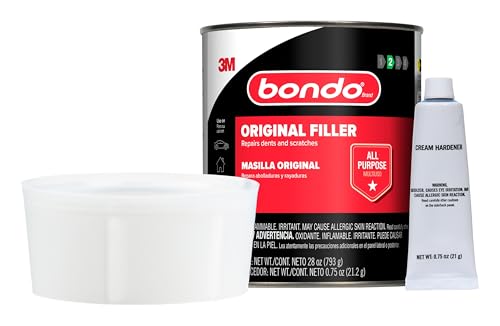
Our Bondo Body Filler delivers professional-grade auto body repair for dents, rust holes, and collision damage on cars, trucks, and motorcycles. The two-part polyester formula bonds permanently to metal, fiberglass, wood, and most rigid plastics.
We engineered this body filler to sand smooth in minutes without cracking or shrinking. Whether you're patching a small door ding or rebuilding a quarter panel, Bondo creates a rock-solid foundation that holds paint and primer flawlessly.
Formula & application specs
Formula & Bonding Properties
Bondo body filler uses a two-part polyester resin system that creates molecular bonds with automotive substrates. The base resin combines with our proprietary hardener cream to trigger a chemical cure that locks into metal grain, fiberglass weave, and surface irregularities.
This isn’t a surface-level patch. The cured bondo car repair creates a cross-linked polymer matrix stronger than many original body panels. We formulated it to flex slightly with sheet metal while maintaining rigidity on fiberglass components.
Surface Preparation & Application
Clean Metal for Maximum Adhesion
Grind away paint, primer, and rust down to bare metal using 36-80 grit sandpaper or a grinding disc. Bondo bonds strongest to abraded surfaces with visible scratch patterns. Wipe the repair area with acetone or wax-and-grease remover to eliminate contaminants.
Mixing & Spreading Technique
Dispense filler onto a clean mixing board and add hardener in a 50:1 ratio by volume. Fold and knead the two components together until the color becomes uniform with no streaks. Work quickly—you have 3-5 minutes before the mixture stiffens.
Sanding & Finishing for Paint
Bondo reaches sandable hardness in 15-30 minutes depending on temperature and hardener ratio. Test by scratching an edge—if it powders instead of gumming, it’s ready to shape.
Start with 36-grit or 40-grit sandpaper on a long sanding board to knock down high spots and establish contour. Progress through 80-grit, 120-grit, and 180-grit to refine the surface. The repair should feel flush with surrounding panels when you run your hand across it.
More Automotive Body Repair Solutions


Rated 4.8 by verified buyers


Common Questions About Bondo Body Filler for Cars
Use approximately 1 inch of hardener cream per golf-ball-sized amount of filler. This creates a 50:1 ratio by volume and gives you 3-5 minutes of working time.
Adding more hardener speeds the cure but can cause brittleness and cracking. Using too little extends working time but may result in a soft, under-cured repair that won't sand properly. Mix thoroughly until the color is uniform with no streaks.
No, bondo car filler bonds strongest to bare metal, fiberglass, or wood. Paint and primer prevent molecular bonding and will cause the repair to peel or crack.
Sand or grind the repair area down to the substrate using 36-80 grit abrasives. Create a visible scratch pattern to maximize surface area for adhesion. Clean with acetone or wax-and-grease remover before applying filler.
Apply Bondo in layers no thicker than 1/4 inch per coat. Thicker applications trap solvents and generate excessive heat during curing, which causes cracking and poor adhesion.
For deep repairs, apply the first layer and let it cure 30 minutes. Sand lightly to roughen the surface, then add subsequent layers. Most professional repairs use 2-3 thin coats rather than one thick application.
Bondo reaches sandable hardness in 15-30 minutes and full cure in 60 minutes at room temperature. You can apply primer as soon as the filler is sanded smooth and dust-free.
Cold temperatures below 50°F slow the cure significantly. Warm the repair area with a heat lamp or work in a heated space for consistent results. Avoid applying paint or primer to tacky filler—test by scratching an edge to ensure it powders.
Standard Bondo bonds to rigid thermoset plastics like fiberglass but not flexible thermoplastics like polypropylene bumpers. Flexible bumpers require specialized adhesion promoters and flexible fillers.
For rigid plastic components like some older bumper covers and body kits, scuff the surface thoroughly with 80-grit sandpaper and test a small area first. The repair may crack if the plastic flexes significantly during use.
Pinholes form when air bubbles trapped during mixing rise to the surface. Apply a thin skim coat of Bondo Glazing & Spot Putty over the sanded filler to fill pinholes without adding significant thickness.
Alternatively, mix a small batch of body filler slightly wetter than normal and squeegee it across the repair with firm pressure to force material into the holes. Sand smooth with 180-220 grit after curing.
No, you must remove all rust before applying Bondo body filler. Active rust continues to spread underneath filler and will cause the repair to fail within months.
Grind or sand rust down to bright, clean metal. For rust perforation, cut out the affected area and weld in a metal patch, or use Bondo Metal Reinforced Filler for structural repairs. Coat bare metal with epoxy primer if you can't apply filler immediately to prevent flash rusting.