


Bondo Hair Filler
We engineered Bondo Hair with long-strand fiberglass reinforcement to bridge gaps and repair large damaged areas where standard body fillers fall short. This professional-grade formula combines exceptional adhesion with superior sandability, making it the go-to choice for automotive collision repair, marine restoration, and heavy-duty home projects.
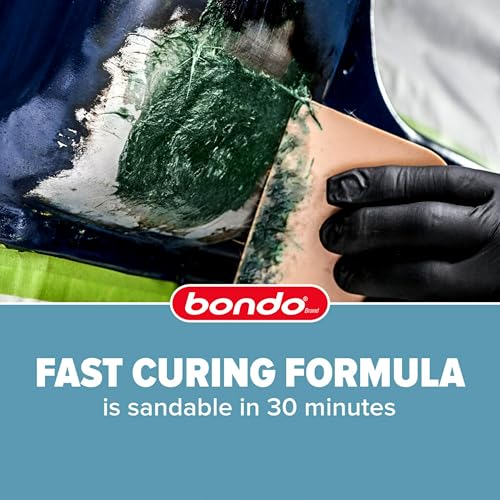
The fiberglass strands distribute throughout the repair area to add structural integrity while resisting cracking and shrinkage. Our formula cures in minutes, sands smooth with standard tools, and accepts paint, primer, or gel coat for a factory-finish result.
Formula & application specs
Fiberglass Reinforcement & Structural Performance
The defining characteristic of bondo hair is its long-strand fiberglass content, which transforms ordinary body filler into a structural repair material. We suspend these strands throughout the polyester resin base so they distribute evenly across the damaged area during application.
Unlike short-fiber fillers that rely primarily on resin strength, the fiberglass strands create a cross-hatched network that bridges voids and resists point loading. This makes the cured filler ideal for repairing rusted-through panels, impact damage, and areas where metal has been cut away.
Application Surface Compatibility
Approved Substrates
Bondo hair adheres tenaciously to properly prepared metal, fiberglass, SMC (sheet molded compound), aluminum, galvanized steel, wood, masonry, and most rigid plastics. We formulate the resin system to chemically bond rather than simply mechanically grip, which is why surface preparation matters so much.
Clean the repair area with wax and grease remover, then scuff with 80-grit sandpaper to create mechanical tooth. For bare metal, apply directly after scuffing. For previously painted surfaces, sand through the paint to expose substrate or apply over a compatible epoxy primer.
Mixing Ratio & Working Time
We include cream hardener with every can—the standard mixing ratio is two percent hardener by volume, which translates to roughly a golf-ball-sized ribbon of hardener per softball-sized portion of filler. Mix on a clean non-porous surface using a plastic spreader in a folding motion until the color is uniform with no streaks.
Working time at 70°F is approximately 5-7 minutes from initial mixing. Higher temperatures accelerate cure, while lower temperatures extend working time. Add slightly less hardener in hot weather to extend workability, but never exceed the 3% maximum or reduce below 1.5% minimum.
More Professional-Strength Fillers


Rated 4.8 by verified buyers


Common Questions About Bondo Hair Filler
Bondo hair adheres to rigid plastics like SMC and fiberglass-reinforced composites commonly used in truck bumpers and older vehicle body panels. It will not flex enough for modern thermoplastic bumper covers (PP, TPO) that require flexible adhesives.
For flexible plastics, the repair will crack as the bumper flexes. Test adhesion on an inconspicuous area first, and consider a flexible bumper repair adhesive instead if the substrate bends easily by hand.
We recommend maximum application thickness of 1/4 inch per coat for proper curing. Thicker applications may not cure completely in the center due to limited hardener penetration and heat buildup during the exothermic curing reaction.
For deeper repairs, apply in multiple 1/4-inch layers, allowing each to cure fully before adding the next. The fiberglass strands will bridge gaps up to 1/2 inch without sagging, but build the repair in stages for best structural integrity and complete cure.
Yes, the fiberglass strand content gives bondo hair excellent vertical hold compared to standard body fillers. The strands create internal structure that resists gravity sag during the 5-7 minute working time.
For best results on vertical or overhead applications, mix slightly less hardener to extend working time by a minute or two, allowing the filler to begin setting up before gravity causes slump. Apply in thin coats if working on severe overhangs.
You can apply bondo hair over fully cured polyester body filler as long as the existing repair is sound and well-adhered. Sand the old filler with 80-grit to create mechanical tooth and remove any gloss or contaminants.
If the existing filler shows cracking, delamination, or moisture intrusion, remove it completely and start fresh. Layering over failed filler will result in the new repair failing as the substrate beneath continues to deteriorate.
Bondo hair contains long-strand fiberglass reinforcement suspended throughout the polyester resin, while regular Bondo body filler uses talc and other mineral fillers without fiber reinforcement. The fiberglass makes it suitable for structural repairs, gap filling, and areas requiring flex resistance.
Regular Bondo excels at shallow cosmetic repairs where smooth sandability matters more than structural strength. Use the hair formula when bridging holes or repairing areas that see stress or flexing; use standard filler for door dings and minor surface damage.
The filler reaches sandable hardness in 20-30 minutes at 70°F, but we recommend waiting at least one hour before applying primer to ensure complete cure throughout the repair depth. For thicker applications or cooler temperatures, allow 2-3 hours.
You can apply epoxy primer as soon as the surface sands to dust without gumming. For polyester primer-surfacers, wait for full cure to avoid solvent entrapment. Most automotive paint systems can be applied 24 hours after the repair for complete chemical crosslinking.
The cured filler resists water intrusion and won't delaminate from moisture exposure, making it suitable for marine and exterior applications. However, it is porous and must be sealed with primer or gel coat to prevent water absorption over time.
For below-waterline marine applications, topcoat with epoxy barrier coat or marine gel coat. For automotive or architectural use, apply two-part epoxy primer or polyester primer-surfacer before painting. Unsealed filler will eventually absorb moisture and potentially degrade the repair bond.