

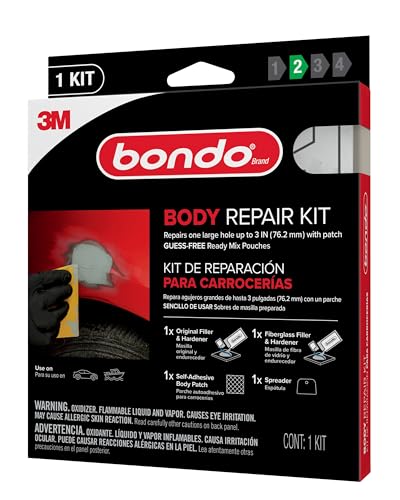


Bondo Body Repair Kit
We've packed everything you need for professional-grade auto body repair into one complete kit. Our flagship Bondo Body Repair Kit includes our trusted polyester body filler, cream hardener, application spreader, and two grades of sanding paper — all the essentials to repair dents, dings, and rust damage on cars, trucks, and recreational vehicles.
Whether you're restoring a classic, fixing collision damage, or preparing surfaces for paint, this kit delivers the same formulation trusted by professional body shops for over 60 years. The filler cures in minutes, sands smooth, and creates a factory-level finish that's ready for primer and paint.
What's Included in Your Kit
What's Included in the Kit
Every Bondo kit ships with a full quart of our premium body filler — enough to repair multiple dents or cover larger damaged areas. The included cream hardener works at a precise ratio to the filler, giving you control over working time and cure speed.
You’ll also find a professional-grade plastic spreader designed to flex with contours while maintaining even pressure. Two sheets of pre-cut sandpaper (80-grit for shaping, 180-grit for smoothing) complete the package, so you can move from application to paint-ready finish without additional tools.
Mixing and Application Guidelines
Hardener Ratio and Working Time
Our bondo kit uses a simple 50:1 filler-to-hardener ratio for consistent results. Squeeze a golf-ball-sized amount of filler onto a clean mixing board, then add a 1-inch ribbon of cream hardener. Mix thoroughly for 30-60 seconds until you see a uniform pink color with no streaks.
You’ll have 5-8 minutes of working time before the mixture begins to firm — plenty of time to spread, shape, and feather edges. Apply in layers no thicker than 1/4 inch for best adhesion and minimal shrinkage.
Sanding and Finish Preparation
Once the filler cures hard to the touch (typically 15-30 minutes), begin shaping with the included 80-grit sandpaper. Use firm, even strokes to knock down high spots and blend the repair into the surrounding surface.
Switch to 180-grit paper for final smoothing. Check your work frequently with a guide coat or bare hand — you’re looking for a seamless transition with no pinholes or low spots.
Complete Your Auto Body Repair Setup


Rated 4.8 by verified buyers
Common Questions About the Bondo Body Repair Kit
The 1-quart container provides approximately 1 pound of body filler, which covers roughly 4-6 square feet at typical repair thickness (1/8 inch). Deeper repairs or multiple dents will reduce coverage.
For reference, most door dings, small dents, and rust hole repairs use 2-4 ounces of mixed filler. A single kit typically handles 3-5 average-sized repairs before you need a refill.
Our standard body filler works best on rigid surfaces like metal, fiberglass, and wood. Flexible bumper covers and soft panels require a specialized flexible filler that moves with the substrate without cracking.
If you're repairing a hard plastic component (like an ABS spoiler or rigid truck bed liner), this kit will bond and sand beautifully. For soft or semi-flexible parts, check out our Bondo Flexible Filler for lasting results.
The bondo kit filler cures to a sandable hardness in 15-30 minutes at 70-80°F. Warmer temperatures speed curing, while cold weather extends the wait.
You'll know it's ready when the surface feels hard to the touch and produces dust (not gummy strings) when you test-sand an edge. Starting too early clogs sandpaper and leaves scratches; waiting too long makes shaping harder but doesn't hurt the repair.
We recommend a 50:1 filler-to-hardener ratio by volume — roughly a golf-ball-sized dollop of filler to a 1-inch ribbon of cream hardener. Mix until you see uniform pink color with no streaks.
Adding more hardener speeds curing but shortens working time and can make the repair brittle. Too little hardener leaves the filler soft or tacky. The included tube dispenses the right amount when you match the visual guide in our instructions.
No — apply body filler directly to clean, bare metal or fiberglass for best adhesion. Remove paint, rust, grease, and wax with sandpaper or a solvent wipe before spreading filler.
Primer goes on after you sand the cured repair smooth. The filler itself doesn't require a primer base, but the repaired area needs primer before paint to ensure proper color coverage and corrosion protection.
Absolutely. If you find pinholes, low spots, or uneven areas after the first coat cures and you sand it, simply clean the surface and apply a second thin layer of mixed filler.
Let each coat cure fully and sand it before adding the next. Most professional repairs involve 2-3 coats to achieve a flawless finish, especially on deep dents or irregular shapes.
Once catalyzed, bondo kit filler generates heat as it cures. Scrape excess onto cardboard or a disposable surface and let it harden fully before throwing it in the trash — never dispose of wet, curing filler in plastic bags or containers.
Unmixed filler and hardener are not hazardous waste, but check your local regulations for disposal guidelines. The plastic spreader and empty containers are recyclable in most municipal programs.