
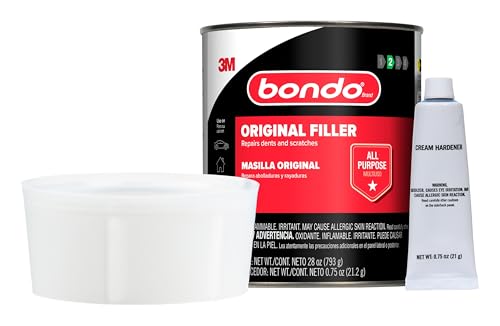


Bondo Body Filler
Our original Bondo Body Filler has been the industry standard for automotive and marine repairs since 1955. This two-part polyester resin formula bonds to metal, fiberglass, masonry, and wood surfaces, filling dents, rust holes, scratches, and gouges up to 1/4 inch deep.
We designed this filler to spread smoothly and cure quickly — you can sand it in just 15 minutes. The cured surface accepts paint, primer, and finishing products without cracking or shrinking, making it the go-to solution for collision repair shops, marine fabricators, and DIY restorers working on everything from classic cars to boat hulls.
Formula & application details
Formula & Bonding Properties
Our bondo filler uses a catalyzed polyester resin system that creates molecular bonds with clean, prepared surfaces. The base resin remains stable until you add the included cream hardener, which triggers an exothermic curing reaction.
Surface Compatibility
This formula adheres to bare metal (steel, aluminum, galvanized), fiberglass, rigid plastics, masonry, and wood. We engineered it to flex slightly with sheet metal while maintaining rigidity on fiberglass panels, preventing the stress cracks common with older lacquer-based fillers.
Mixing & Application Process
Squeeze a ribbon of cream hardener along the filler at a ratio of approximately 2% hardener to filler by volume — roughly one inch of hardener per golf-ball-sized portion of filler. Mix thoroughly on a clean, non-porous surface using the included spreader until the mixture shows a uniform pink color with no streaks.
Working Time & Cure
You’ll have 3 to 5 minutes of working time at 77°F before the mixture begins to harden. Apply in layers no thicker than 1/4 inch, spreading with firm pressure to eliminate air pockets. The filler becomes tack-free in 5 to 10 minutes and sandable in 15 minutes.
Surface Preparation & Finishing
Clean the repair area with wax and grease remover, then sand with 80-grit paper to create mechanical tooth for adhesion. Remove all rust, loose paint, and contaminants — the filler bonds only to clean, solid material.
Sanding & Shaping
Once the bondo filler is fully cured, shape it with 36 or 80-grit paper on a sanding block or dual-action sander. Feather the edges into the surrounding surface, creating a gradual transition rather than a sharp ledge. Progress through 120, 180, and 220-grit papers for a smooth finish.
Complete Your Auto Body Repair Kit


Rated 4.8 by verified buyers


Common Questions About Bondo Body Filler
Apply bondo filler in layers no thicker than 1/4 inch for optimal curing and adhesion. Thicker applications trap solvents and may crack or remain soft at the base.
For deeper repairs, apply the first 1/4-inch layer and let it cure fully, then add subsequent layers. Large voids or structural damage require fiberglass mat backing or metal reinforcement before filling.
You must remove all rust down to bare, clean metal before applying bondo filler. Rust continues to grow under filler and breaks the bond, causing the repair to fail.
Sand or grind rusted areas until you see bright metal, then treat with a rust converter if needed. Wipe the surface with wax and grease remover immediately before applying filler for maximum adhesion.
Soft filler after extended time usually means insufficient hardener or cold working temperature. The mixture requires approximately 2% hardener by volume — one inch of cream hardener per golf-ball-sized portion of filler.
Cold workshops below 50°F dramatically slow curing. Move your project to a warmer area or use a heat lamp at a safe distance to speed the reaction. Verify your hardener hasn't separated or expired, which reduces its effectiveness.
Standard bondo filler does not flex enough for most automotive plastics and will crack with bumper flexing. Use a dedicated flexible bumper repair adhesive designed for thermoplastic substrates instead.
This filler works well on rigid fiberglass, SMC (sheet molded composite), and thermoset plastic panels that don't flex during normal use. Test adhesion on an inconspicuous area if you're uncertain about material compatibility.
Yes, you must apply automotive primer over fully cured and sanded bondo filler before topcoat. The porous filler surface absorbs paint unevenly and shows through color coats if not sealed.
Use a high-build primer-surfacer for best results, applying 2 to 3 coats and wet-sanding with 400-grit paper. This creates a uniform surface that accepts paint identically to the surrounding factory finish.
An opened container of bondo filler remains usable for 1 to 2 years when stored sealed in a cool, dry location. Press plastic wrap directly onto the filler surface before replacing the lid to minimize air exposure.
If the product has hardened around the edges, separated into layers, or contains lumps when stirred, it has exceeded its shelf life and should be discarded. Hardener tubes last approximately 18 months sealed at room temperature.
Yes, fully cured bondo filler can be drilled, tapped, and shaped with standard metalworking tools. The rigid polyester resin holds threads well for mounting brackets, trim clips, and fasteners in non-structural applications.
For load-bearing threads or high-stress attachments, use metal backing plates or rivet nuts embedded in the filler. The material is strong but not as durable as the original substrate for repeated fastener installation and removal.