
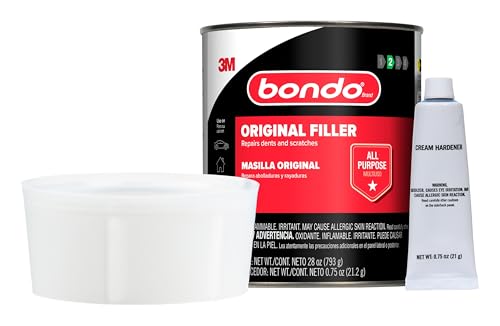



Bondo Body Filler
Our original Bondo body filler delivers professional-grade results for automotive and household repairs. We formulated this two-part polyester putty to fill dents, rust holes, and scratches on metal, fiberglass, and wood surfaces with superior adhesion and minimal shrinkage.
Since 1955, professional body shops and DIY enthusiasts have trusted this formula to restore vehicles, marine craft, and home fixtures. The putty cures in 15-25 minutes, sands smooth without clogging paper, and creates a permanent repair that withstands decades of use.
Formula & performance specs
Two-Part Polyester Formula & Mixing
Our bondo putty uses a polyester resin base activated by a red cream hardener included with every can. The chemical reaction between resin and hardener creates a thermoset polymer that bonds at the molecular level to properly prepared surfaces.
Mix 2% hardener by volume — roughly a golf-ball-sized amount of putty to a 1-inch ribbon of hardener on a clean mixing board. Use a plastic or metal spreader to blend both components until you achieve a uniform pink color with no streaks. Working time ranges from 4-6 minutes after mixing, so prepare only what you can apply in that window.
Surface Preparation & Application
Proper surface prep ensures permanent adhesion and prevents delamination. Clean the repair area with wax and grease remover, then sand down to bare substrate using 80-grit sandpaper. Feather the edges of the damage area 1-2 inches beyond the repair zone to create a gradual transition.
Apply mixed filler with firm pressure using a body file spreader or putty knife, forcing material into the damaged area. Build slightly proud of the surrounding surface — our formula has zero shrinkage, so excess material is intentional. For deep dents exceeding 1/4 inch, apply in multiple layers, allowing each to cure before adding the next.
Compatible Surfaces & Repair Types
This polyester filler adheres permanently to bare steel, aluminum, galvanized metal, SMC body panels, fiberglass-reinforced plastic, and solid wood. Marine repair professionals use it on boat hulls, transoms, and stringers exposed to constant moisture.
For automotive applications, we recommend it for collision damage, rust repair after cutting away compromised metal, and filling seams in custom fabrication. Home users repair wooden door frames, window sills, furniture, and masonry with the same product.
Complete Your Automotive Repair Kit


Rated 4.8 by verified buyers


Common Questions About Bondo Body Filler
Mix 2% cream hardener by volume — approximately a 1-inch ribbon of hardener for every golf-ball-sized amount of filler. Too much hardener causes the mixture to cure in under 2 minutes and creates a brittle repair. Too little extends working time beyond 10 minutes but may result in incomplete cure.
Mix on a clean plastic or metal board using a spreader, blending until you see a uniform pink color with no white or red streaks. The mixture remains workable for 4-6 minutes at 77°F before it begins to harden.
No — polyester body filler must bond directly to bare substrate for permanent adhesion. Sand or strip down to bare metal, fiberglass, or wood before application.
If you apply over paint, the filler may appear to stick initially, but it will delaminate when stressed. The polyester resin creates a chemical bond with raw material, not a mechanical bond with coated surfaces. For repairs over primer, sand through to substrate in the damaged area and feather the edges into the surrounding primer.
Apply up to 1/4 inch thickness in a single layer for optimal cure and adhesion. Deeper applications may trap uncured resin in the center, leading to soft spots or delayed cracking.
For dents or holes deeper than 1/4 inch, build in multiple layers. Apply the first layer, let it cure fully (15-25 minutes), then sand the surface and apply the next layer. Alternatively, use our Bondo Fiberglass Resin with cloth mat for structural repairs exceeding 1/2 inch depth.
Start with 36 or 80-grit on a sanding block to remove excess material and shape the repair area. Progress to 120-grit for contouring, then finish with 180-grit before applying primer.
Cured polyester filler machines like hardwood — aggressive grits cut efficiently without loading the paper. Avoid grits finer than 180 on bare filler, as they burnish the surface and reduce primer adhesion. After priming, use 320-400 grit wet sandpaper to level the primer before paint.
You can apply primer immediately after final sanding — typically 30-60 minutes after initial application. The filler reaches full cure in 15-25 minutes at 77°F, after which it's ready for topcoats.
We recommend applying a catalyzed primer-surfacer or epoxy primer over the sanded filler to fill minor scratches and seal the repair. Allow primer to cure per manufacturer instructions (usually 1-24 hours) before applying basecoat or single-stage paint.
Our polyester formula has zero shrinkage once cured — the repair remains at the shaped height indefinitely. Cracking occurs only when filler is applied over paint, onto flexible substrates, or in layers exceeding 1/4 inch thickness.
Proper surface preparation prevents cracking. Bond the filler to bare, rigid substrate, apply in thin layers, and ensure complete cure between coats. Repairs completed correctly in 1985 remain intact today on vehicles and boats exposed to extreme temperature cycling and vibration.
No — standard Bondo body filler does not flex and will crack on thermoplastic bumper covers made from TPO or urethane. These materials expand and contract with temperature changes, requiring a flexible repair product.
Use our Bondo Bumper Repair Kit formulated specifically for plastic substrates. It contains flexible resin and reinforcing tape designed to move with the bumper without delaminating or cracking.